

27th August 2026
Following our recent communications regarding typhoon disruption across China and Asia, we would like to provide a further important update on the developing situation.
Unfortunately, the effects of the recent severe weather are now being compounded by significant congestion across several of China’s major export ports, particularly Shanghai, Ningbo and Yantian (Shenzhen).
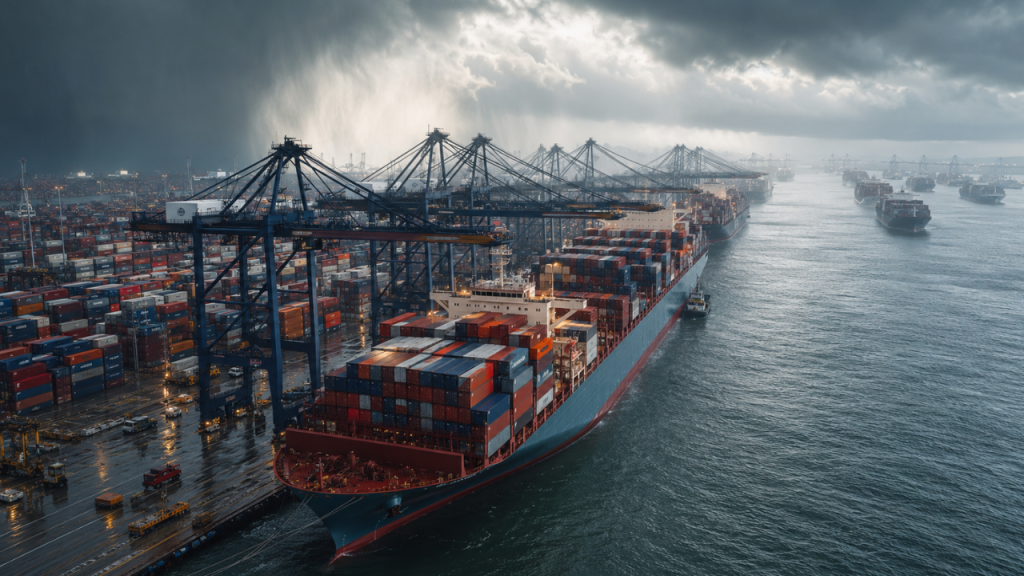
While it had been hoped that port operations and vessel schedules would begin returning to normal following the recent typhoons, the recovery is proving considerably more challenging. Large vessel and container backlogs, schedule disruption and further adverse weather are now creating interconnected delays across the wider Asian shipping network.
Shanghai – Significant Vessel Delays
Congestion at Shanghai has intensified considerably. Current industry reports indicate that the longest berthing delays at Yangshan have exceeded 12 days, while waiting times at Waigaoqiao are averaging approximately 8 days.
Some services are experiencing delays of approximately 10–14 days, while high container yard utilisation is adding further pressure to terminal operations.
In an attempt to recover schedules, shipping lines are adjusting rotations and, in some cases, omitting scheduled port calls. This can result in containers being rolled onto subsequent sailings and further changes to originally advised departure and arrival dates.
Ningbo – Further Disruption Following Typhoons
Ningbo continues to experience significant congestion following recent typhoon disruption. An extended port closure of approximately 88 hours contributed to a substantial backlog of vessels waiting to enter the port. While operations subsequently resumed, continued vessel arrivals have made clearing this backlog increasingly difficult.
Further disruption has also occurred as a result of Typhoon Saudel and strong winds, with Ningbo-Zhoushan terminals introducing temporary restrictions to container gate-in and pick-up operations. This is adding further pressure to an already congested situation and is likely to result in additional vessel bunching, schedule changes and delays to export shipments.
South China – Yantian / Shenzhen
The disruption is not limited to East China. Yantian is also experiencing operational pressure, with tighter terminal gate-in controls currently affecting South China exports. Heavy export containers are currently restricted from entering the terminal more than approximately seven days ahead of the vessel’s expected berthing.
As vessel schedules continue to change, exporters and forwarders are having to constantly monitor revised terminal receiving windows and cut-off dates.
Where containers cannot be delivered to port as originally planned, cargo may need to remain at factories, warehouses or external storage locations for longer than expected.
The Wider Impact Across Asia
One of the most important points for customers to understand is that these problems are not isolated to individual ports. Shanghai, Ningbo and Yantian form key parts of many international vessel rotations. When vessels are delayed at one port, those delays travel with the vessel to subsequent ports.
This creates a domino effect across the network – contributing to vessel bunching, missed berthing windows, port omissions, equipment displacement and further schedule changes elsewhere. Current industry estimates suggest that more than 2.4 million TEU of vessel capacity has been affected or delayed across Northeast Asia as carriers respond to the current congestion and schedule disruption.
As a result, the expectation is that a full return to normal operating conditions is likely to take several weeks rather than several days.
What Does This Mean for Your Shipments?
Customers with ocean freight moving from China should currently be prepared for:
- Extended vessel waiting and overall transit times
- Departure and arrival dates changing at short notice
- Port omissions and changes to vessel rotations
- Containers being rolled onto later sailings
- Restricted terminal gate-in windows
- Delays to container collections and deliveries
- Continued pressure on vessel space and equipment availability
- Missed connections and knock-on delays at subsequent ports
- Potential additional storage, detention or diversion costs in some circumstances
The extent of the disruption will vary considerably depending on the port, carrier, service and individual shipment.
Please Allow Significantly More Lead Time
Given the severity of the current situation, we strongly recommend that customers do not plan upcoming China shipments around normal transit times or scheduled vessel dates. For affected ocean freight movements, we recommend allowing approximately 15–20 days more lead time than would normally be planned, wherever your supply chain allows.
This does not necessarily mean that every shipment will experience a 15–20 day delay. Rather, it provides a sensible contingency while carriers and ports work through the current disruption. For particularly urgent or time-critical cargo, please speak with your usual contact as early as possible. Depending on the circumstances, we can review whether alternative routings, services or transport modes may be appropriate.
What We Are Doing
We appreciate the significant impact that these delays can have on your business, particularly where stock availability, production schedules or customer commitments are dependent on goods arriving within a particular timeframe.
Our team, together with our overseas partners, is continuing to:
- Monitor individual vessel schedules and port calls
- Check carrier schedules before confirming bookings
- Monitor conditions across Shanghai, Ningbo and South China
- Review alternative routings where appropriate
- Monitor revised terminal gate-in and cut-off requirements
- Review affected shipments as carrier schedules change
- Communicate material changes to customers as quickly as possible
Unfortunately, the underlying causes of the current disruption – including severe weather, port closures, vessel congestion and decisions by carriers to alter schedules or omit ports – remain outside the control of freight forwarders.
What we can control is how proactively we manage your freight around these circumstances, and our team will continue to do everything reasonably possible to minimise disruption and keep you informed.
Thank You for Your Understanding
We recognise that repeated delays are frustrating for everyone involved in the supply chain. The current situation is exceptional, and even after weather conditions improve, the accumulated vessel and container backlog means that recovery will not be immediate.
We therefore ask customers to allow additional flexibility when planning upcoming China shipments and, wherever possible, avoid making critical delivery commitments based solely on currently published vessel schedules.
We will continue to monitor the situation closely and provide further updates as conditions develop. If you have urgent, time-sensitive or particularly critical shipments from China, please contact your usual representative so that we can review them individually.